tips for creating structurally sound cakes
Building the Cake: Guidelines for the Decorator
By Renee Shelton
Some of the more popular questions I'm asked for cake design include:
- How do I get the tiers so straight?
- One of my tiers seemed larger. Why?
- A raspberry poked through the side!
- There was a crack [horizontal or vertical] on the side of mine. How do I prevent this?
- Syrup was leaking out the bottom. Does this happen to you? [Yes, it has.]
- My cake tiers always seem to be of uneven size when I really want them even.
- My [dark chocolate/berry/colored buttercream] filling was showing through the side of my white wedding cake.
- My cake seemed to shift and the top half "slid" to the left [or right]. Why did it do that?
My Tips for Successful Cake Making
Three Basic Goals For a Finished Cake
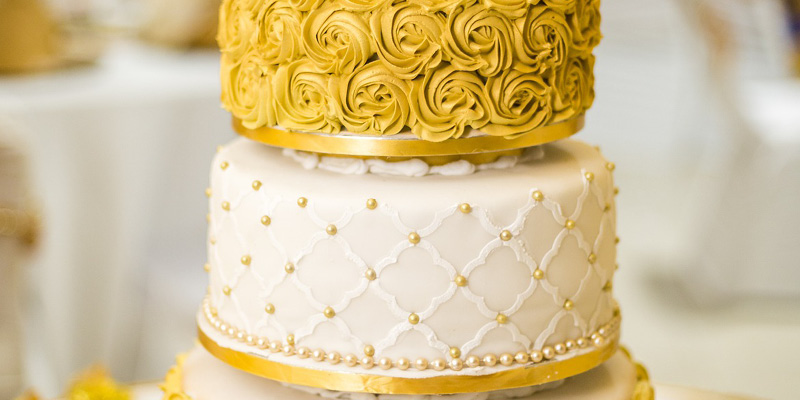
- Sides: straight and even.
- Tiers: evenly spaced, not just in proportion to the others, but even heights and pillar spacing.
- Final coating: no cake layers, fillings, spreads, or internal garnishes showing through, or cracks forming.
Four basics of building a multi-level cake
- The cake itself.
- Fillings, if using, plus any syrups or internal garnishes.
- Tier assembly.
- First and final coats.
Basic One: The Cake
Use a cake that is firm, and not too airy or open celled. A cake that is too soft, spongy, or open celled is not a strong cake, and will fall apart when given the chance.
The layers must be cut evenly. This is not just meaning a perfect cut with no dips, divots or 'flaps' from the knife cuts on the cake, but having each slice from the cake being even with each other (for example if you cut an inch-thick layer for the first cut, make each subsequent layer an inch; if it's 2 inches, make sure each other sliced layer is inches, too). The result of an even layered cake: when the slices are cut from the finished cake, you'll be able to show off the neat and even layers of cake and filling.
The top and bottom of the cakes should be trimmed off. The top may be slightly rounded, and the bottom may hold a shell or two from the eggs. Trimming the top and bottom also ensures each cake slice is uniform in color for each layer with no tell-tale brown from the top or bottom.
Make sure there is an even spacing of the cake layer diameters; otherwise when assembled, there will be a noticeable difference in diameters between the tiers, which especially stands out when stacked (unless that is your intention, then you can make them whatever diameter you need them to be). See below.
For example:
- 14 x 10 x 6 = each is spaced 4" in diameter from each other
- 12 x 9 x 6 = each is spaced 3" in diameter from each other
- 12 x 10 x 8 x 6 = each is spaced 2" in diameter from each other
Basic Two: Fillings, Syrups Internal Garnishes, Spreads
Syrups:
Do not over-moisten. While moistness is key to a great tasting cake, there is such a thing as over doing it. If too much syrup is added, it will lead to leaking on the bottom, and can make the cake layers unstable.
It is important to note that syrups not only add moisture to a cake, but can add dimension to the cake when flavored, which can compliment or highlight a filling or internal garnish. Just watch how much you add to each layer.
Fillings:
Choose a filling that will set up if you're making it fresh, and make sure it is firm enough to handle assembling. For example, if you are making freshly made mousse - make sure it is firm enough to spread before layering it with the cake layers. Also, choose one that isn't liquid or runny when assembling.
Choose a filling that is appropriate for the decorating or the event. For example, if the cake will be sitting out for extended periods for decorating OR for serving, a light whipped cream and strawberry filling would not be the best choice.Internal Garnishes and Spreads:
If using berries, make sure they are not so over-ripe that they seem to 'smoosh' by just looking at them.
If cut up fruit or berries are needed, do not use them for a cake that will sit out for extended periods. The fruits may weep or bleed and their juices may run.
If chopped bananas are being used and you have tossed them in an acidic liquid to help prevent browning (like lemon or pineapple juice), be sure they are carefully drained and dried properly before adding them to the cake.
Spreads:
If a spread (like preserves, jams, ganache, lemon curd, etc.) will be used before the filling is placed or piped on the layers, make sure it is thin. You don't need much, and they are usually soft and don't readily set up on their own (the exception being a traditional ganache). If using a very thick layer of a plain curd for example, there is a possibility a tier can 'shift' after setting up, where a layer literally slides or shifts since the filling and the cake will not adhere to it.
A spread is used mostly to add flavor or give some color. An example of flavor would be dark chocolate ganache used with a mocha buttercream and an example of color would be raspberry jam used with a white chocolate mousse. Note that is different from the actual filling. Remember spreads are used to highlight the cake only; it's not the actual filling.
Basic Three: Tier Assembly
Make sure all the cut cake layers are even, and evenly grained. If one cut layer for one of your tiers seems to be very porous, has a crack or a hole in it, it usually can be compensated for, but be wary. A bottom tier or middle tier with a heavily porous cake will not hold up to syrups or soft fillings well and will sometimes 'disappear' when left on the cake table for extended periods.
I always pipe my buttercream around my layers with a round tip, making it as tall as my filling. This helps to keep the filling in place (not seep through layers), makes for an easy first coat, and keeps the assembly straight for the tiers.
The filling needs to be even. Make sure when you add the filling you don't overfill the layer—when the filling is thicker in the center than on the sides—because once you top it with another layer of cake and press down, there is no place for the filling to go except out the sides.
If you use a jam or curd for a spread before you add your filling, make sure it is thin and even. This is so when you pipe your buttercream around the edge, the filling doesn't shift or slide when crumb coating.
When all the cake layers have been cut evenly (remember, not just a perfect knife cut but each cut layer per tier is even in height) and the fillings have been put on with the same thickness, the tiers (when assembled) will theoretically be even as well, which is an ultimate goal for the finished product of multi-tiered cakes.
Basic Four: First Coat and Final Coat
If you have piped the buttercream around the edges, the filling is encased and the sides will be easily straightened as they're being built.
If your fresh-made mousse has not set up firmly yet and you still want it for assembly - take note that it will be very loose when put between the layers. When this happens, instead of putting on a cake wheel and twirling to do the first coat, use an offset or straight spatula (whichever you are more comfortable using) and finish the crumb coat on the work bench. Make the sides even and smooth with the buttercream and smooth out the tops, and then carefully lift and place on a flat, even surface in the cooler until the buttercream has chilled and the filling has set. This is best done directly on sheet pans. Twirling seems to make the soft fillings run.
This may sound like a no-brainer, but always put your tiers on a flat, even surface. I've seen cakes with beautiful, even first and final coats in walk-ins—buttercream chilled and fully set, ready for decoration—only to be removed from a bumpy, bowed or uneven sheet pan and placed on a cake board or the final display stand (and no surprise) it cracks. This is because the soft buttercream around the cake tiers have conformed and set up to the curvature of the uneven surface. Once it is placed on a flat surface, the cake levels out and cracks.
You want to make your first coat, "crumb coat", as even and smooth as possible. If your tiers have shifted as they were being built, simply go around with your spatula and straighten while the buttercream is still soft. If the cakes are very large, 16-inches or larger in diameter, or if the filling is soft, you may need to get your hands 'dirty' and manually shift to straighten the sides. If any curd or jam bleeds now when the first coat is being put on, remove any large, oozing pockets and cover with buttercream. If a berry pokes through the piping of buttercream, push it back in now before it hardens in place since it will undoubtedly show through the final coat.
The key to a first coat is to get the tiers ready for the final coat and decoration. You want the entire cake covered in buttercream (thin coat, just making it smooth and removing crumbs and imperfections) so that when it chills, it firms up, resulting in a durable surface for the finishing.
Make sure your first coat is adequate, but not overly thick. There will be a final coat going on to finish up the cake, so it's not necessary to have, say, two inches of buttercream on the outside for the first coat.
If you are using a ganache, a butter-based or shortening frosting, or gelatin-and-whipped-cream in place of the buttercream, the same rules apply:
Use a plain tip for the piping of icing on the outside of the layers to hold in the filling. Use a recipe for both the icing and filling that will firm up or set up upon cooling. Make sure your first coating is straight and even.
These are the general guidelines for building any cake, whether it's for a wedding, a birthday or other occasion, that I have implemented through trial and error and experience. You may find other ways to accomplish the goals or have a quicker way to build your cakes.
In any case, the object is to present a cake that tastes good and is structurally sound. All the decorating in the world will not help a cake that is cracked or split, is leaning to one side, hasn't been leveled out properly or given a good crumb coat, or having multi-tiers varied heights. Taking the time to do the rudimentaries properly will make time spent decorating - time actually worth spent.
This article was first published on pastrysampler.com on August 29, 2009. It was updated on October 4, 2020.
Sources:
Image by Abdul Karim Jalloh from Pixabay.