puff pastry or pâte feuilletée
All About Puff Pastry: Détrempe, Beurrage, Paton, and Recipes for Regular and Inverse Styles
By Renee Shelton
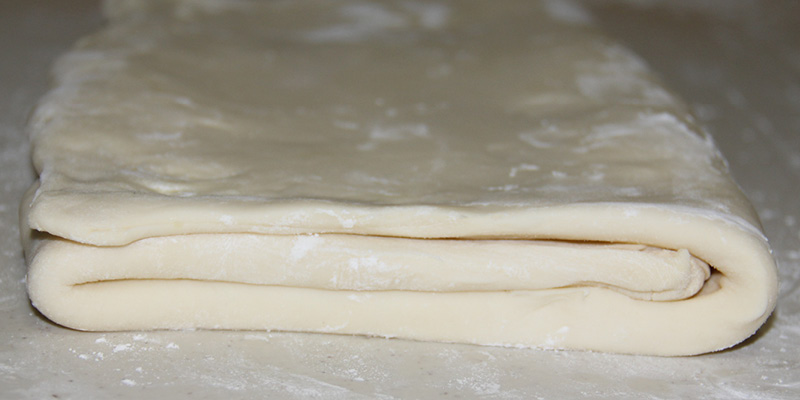
Puff pastry is a special dough made by alternating layers or 'folds' of a simple flour/water paste with a fat. This layering results in a very flaky pastry dough.
Détrempe, Beurrage, and Paton
Puff pastry basically consists of two separate parts: the dough portion or détrempe, and the fat block or beurrage. The détrempe is a very basic dough mixture made up of flour and a liquid, and is used as a base for other doughs. The fat portion could be anything from whole butter to vegan margarine. Once they are put together, each portion is referred to as a paton. The resulting layers create the flaky pastry for which puff pastry is famous.
Puff Pastry Tips
The key to puff pastry is the individual layers. The reason it bakes up so high and with so many very thin layers is each layer of dough is separated by fat. The fat portion and dough are folded multiple times in a certain fashion so as to not mix the two together, but keep them separated.
A trick to making puff dough is having the butter and dough at the same firmness or texture to begin with: the dough shouldn't be too soft or elastic, and the butter shouldn't be rock hard or too soft. If either one is off, you'll end up just kneading the two ingredients together rather than folding them to create the layers that are needed.
Read the recipe carefully - some will specifically call for regular unsalted butter or a butter with a higher butter fat (higher fat and less water content), melted butter, or even vegan margarine. Whatever is called for in the recipe you are reading, follow it as the tester has created a particular formulation to create an even finished product.
Vegan Puff Pastry
Vegan puff pastry will call for vegan margarine. Choose one with zero trans fats or that is non-hydrogenated, and do not use tub margarine due to its higher water content. Since margarine and whole butter will have a different liquid content anyway, don't interchange one for the other. Look for a recipe specially made using that type of fat. If you are looking for a vegan recipe, I recommend the puff pastry recipe from Vegan Baking which is probably the best recipe I've seen for making vegan puff dough.
Puff Pastry Recipes: Traditional and Inverse
Save yourself a trip to the market and create a better product at home by making puff pastry yourself. Puff dough, or puff pastry, is a relatively easy pastry dough to make. All you really need to know is how to create the turns to make the layers of the pastry. Below are two recipes for puff pastry. The first is a traditional puff dough recipe, and the second is an inverse dough puff pastry recipe. A traditional recipe will have the dough part on the outside and the butter on the inside. An inverse puff pastry is where the butter block is on the outside and the dough is on the inside.
Puff Pastry
Makes 1 paton.
- 2 cups unsalted butter
- 4 cups flour
- 1 teaspoon salt
- 1 1/2 cups water (may not use it all)
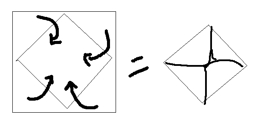
Knead the butter by hand until it is waxy. Shape the butter into a flat, square cake, wrap and chill. Sift flour and salt into a bowl. Gradually add in the water and knead on a smooth floured surface until dough is elastic, about 20 minutes. Wrap the dough; chill for 30 minutes. Roll out the dough on a floured surface into a square 1/2" thick. Roll the edges a little thinner than the center. Lightly flour the square of butter and place it in the center of the dough at an angle. Fold the 4 edges of the dough over the butter:
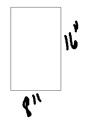
Straighten the dough square and proceed to roll out dough into a rectangle, rolling forward only in one direction, until the rectangle is roughly 8" by 16":
If the dough tears at all, take a little piece from the edges and patch up the hole immediately. This is important as this will trap in any air as the layers are built. Fold the top third of the dough toward you, making the ends as neat as possible, then fold the last third away from you, making three layers of the dough:
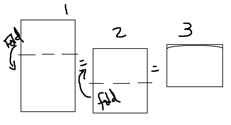
You now have three layers. Take this folded rectangle and give it a quarter-turn, so that the unfolded edge is facing you and the folded edges are facing your sides:
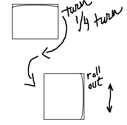
Roll out in one direction, until the dough is roughly the same as the first rectangle, about 8" by 16". You have just finished with one "turn." Wrap this dough and place in the refrigerator. Chill for 30 minutes. Unwrap dough and proceed as above with the rolling, folding and re-rolling and folding. You need to finish 4 more "turns" for the dough, chilling for 30 minutes between each turn so butter is firm enough, and dough is stable enough, to roll out. Always be sure that the unfolded edge of the dough is facing you.
Invers Puff Dough
Makes 2 Patons
- 2 lbs. 10 oz. all-purpose flour
- 6 lbs. 12 oz. Plugra or other European butter (no substitutions)
Mix together. Divide in half. Chill.
- 6 lbs. 8 oz. bread flour
- 2 oz. salt
- 40 oz. water
- 1/2 oz. vinegar
- 2 lbs. melted butter
Mix until it the dough forms a ball. Do not overmix. Divide in half. Chill.
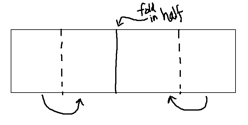
Roll out patons. Place butter mixture on the outside, bread flour mixture on the inside. Seal edges and chill well. Roll out into a long rectangle using a commercial sheeter. Complete three double turns, following the quarter turn principle as above.
This article was first published on pastrysampler.com on January 5, 2008. It was updated on October 3, 2020.
Sources:
Inverse puff pastry recipe from Renee Shelton's recipe files.
Editors of Horizon Magazine; Buehr, Wendy, ed. The Horizon Cookbook and Illustrated History of Eating and Drinking though the Ages. Part Two. US: American, 1968.
"File:Making puff pastry (butter and Water dough ) 5.jpg" by Roozitaa is licensed with CC BY-SA 3.0.